

How to Hang Outdoor Lights, String Lights, and Lanterns That Survive Cape Town Wind
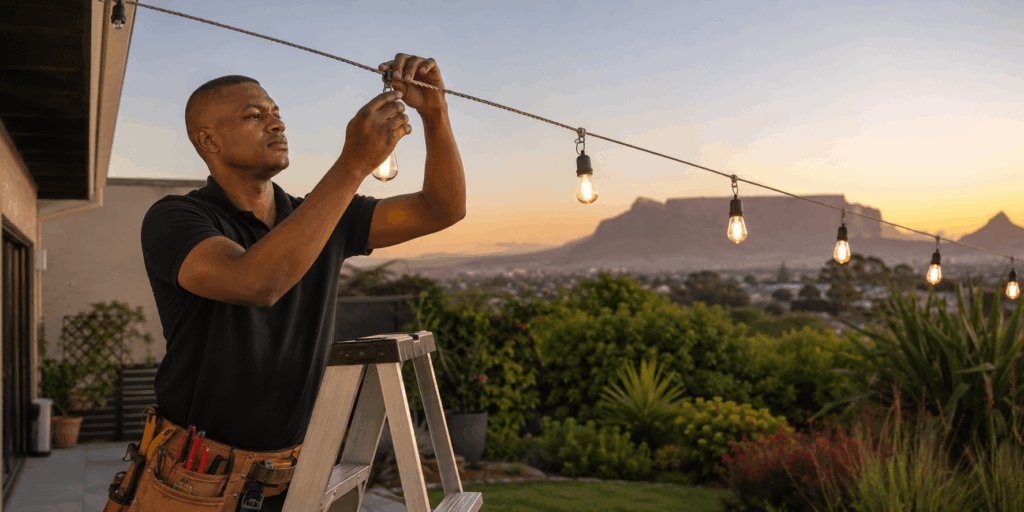
There is nothing quite like a Cape Town summer evening – warm light fading over the mountain, a braai getting going, and a canopy of string lights glowing above the patio. Right up until the South Easter arrives and rips the whole lot down in a single gust. Every Capetonian who has strung fairy lights across a Sea Point balcony or hung lanterns over a Constantia garden knows the frustration of finding them tangled on the paving the next morning.
The problem is almost never the lights themselves – it is how they were hung. Outdoor lighting that survives Cape Town’s wind comes down to the right fixings, the right cable tension, and an understanding of how the South Easter actually behaves. This guide walks you through exactly how to hang string lights, festoon lights, and lanterns so they stay up all summer, and when it is worth calling in a registered Cape Town electrician to do it properly.
Key Takeaways
- The South Easter is the single biggest threat to outdoor lighting in Cape Town – plan for it from the start.
- String lights must be hung on a separate load-bearing steel guy wire, never on the light cable itself.
- Use stainless steel fixings throughout – salt air corrodes standard steel within a season.
- Leave a slight droop in festoon cables and use turnbuckles so you can re-tension after windy spells.
- Any permanent outdoor electrical connection must be done by a registered electrician with weatherproof IP-rated fittings.
1. Understanding the Enemy: Cape Town’s South Easter
You cannot hang outdoor lighting well in Cape Town without first respecting the wind. The South Easter – the “Cape Doctor” – blows hardest from November through to March, exactly when you most want to be entertaining outdoors. On the Atlantic Seaboard, in the City Bowl, and across the Southern Suburbs, sustained gusts of 40 to 60km/h are routine on a summer afternoon, and considerably stronger days are not unusual.
This matters because wind load on a run of string lights is far greater than people expect. Each bulb, each cable, and especially any lampshade or lantern acts like a small sail. Multiply that across a 10-metre festoon run and the force trying to tear your fixings out of the wall becomes significant. The homes most exposed – elevated properties in Higgovale and Tamboerskloof, and anything on the Atlantic Seaboard from Mouille Point to Camps Bay – need the most robust approach.
Why Most Outdoor Lights Fail
- The lights are hung directly on their own thin cable, which stretches and snaps under wind load.
- Fixings are screwed into weak mortar joints or lightweight trellis rather than solid structure.
- Cheap indoor-rated hooks and screws rust through in a single Cape Town season.
- The cable is strung bar-tight, leaving no give, so a single strong gust shears the end fixing clean off.
2. The Golden Rule: Hang the Wire, Not the Lights
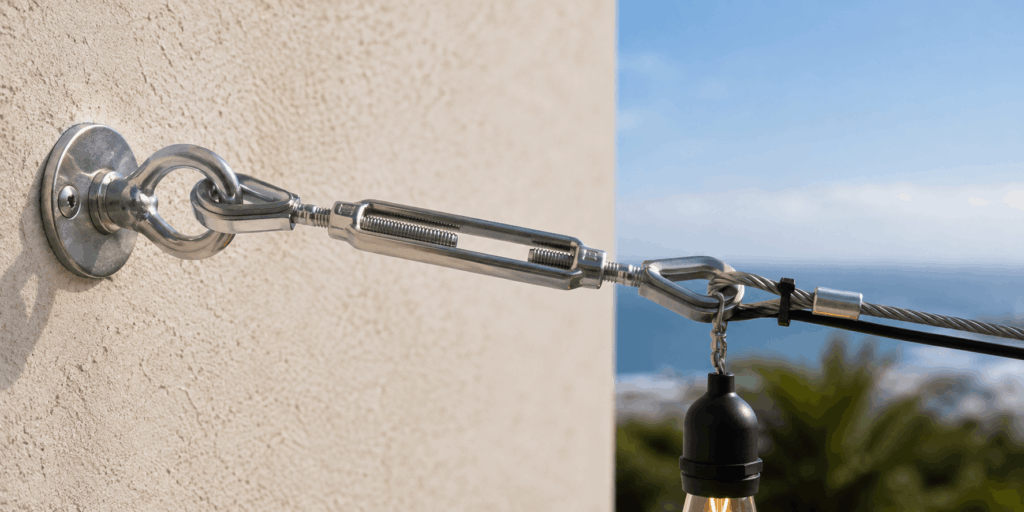
This is the single most important principle in Cape Town outdoor lighting. Your string or festoon lights should never bear their own load across a span. Instead, you run a separate load-bearing catenary wire – a tensioned stainless steel guy wire – between your fixing points, and then attach the lights to that wire.
The steel wire takes all the wind load and tension. The light cable simply hangs alongside it, clipped on every 30 to 40cm, carrying no structural stress at all. This is exactly how professional festoon installations at Cape Town restaurants and wine estates stay up through summer after summer.
What You Need for a Catenary System
- 3mm or 4mm stainless steel wire rope (marine grade 316 for coastal properties).
- Stainless steel turnbuckles at one or both ends for tensioning.
- Stainless steel eye bolts or heavy-duty wall anchors rated well above the expected load.
- Stainless steel wire rope grips and thimbles to form the end loops.
- Stainless steel S-hooks or cable ties to attach the lights to the wire.
Notice the pattern – everything is stainless steel. In Cape Town’s salt-laden coastal air, standard galvanised or mild steel fixings will streak, rust, and fail within a season, particularly anywhere near the Atlantic. This is the same principle our team applies when installing shelves and wall fixings in coastal homes.
3. Fixing Points: Where the Whole System Lives or Dies
Your lights are only as secure as what you anchor them to. A perfect catenary wire is useless if the eye bolt is screwed into crumbling plaster or a rotten timber beam.
Solid Masonry Walls
The best anchor point in most Cape Town homes. Drill into the solid brick or concrete – never just the plaster skim – and use an M8 or M10 stainless steel expansion anchor or chemical anchor. This will hold far more than any string light run will ever demand. Avoid fixing into mortar joints, which are weaker than the brick itself.
Timber Beams, Pergolas, and Fascias
Common over patios and stoeps. Fix into the solid structural timber, not into thin trellis or lattice. Check the timber is sound and not rotten – Cape Town’s wet winters cause hidden rot in exposed pergola timbers. Use stainless steel screw eyes rated for the load, drilling a pilot hole first to prevent splitting.
Free-Standing Poles
Where you have no convenient wall or beam, a set of galvanised or powder-coated steel poles set in concrete footings gives you a permanent, wind-resistant anchor. This is the professional solution for large gardens in suburbs like Constantia, Bishopscourt, and Newlands where light runs need to cross open lawn. For any structural pole installation, the Handyman Homes renovations and alterations team can set proper concrete footings that will not shift.
4. Tensioning, Droop, and the Lantern Question
A common mistake is stringing the wire as tight as possible. Counterintuitively, a wire pulled bar-tight is more likely to fail – it has no give, so every gust transfers its full force directly to the end fixings. A slight, deliberate droop of around 20 to 30cm over a typical span lets the system flex and absorb wind load instead of fighting it.
This is where turnbuckles earn their place. After the first few windy days have settled everything, you can re-tension the wire in seconds. It is worth checking tension at the start of each summer and after any exceptionally strong South Easter.
Lanterns Need Extra Thought
Hanging lanterns are the most wind-vulnerable outdoor lighting of all, because they swing, catch the wind broadside, and put shock loads on their fixing every time they move. For lanterns in Cape Town:
- Hang them from a fixed rigid bracket rather than a long chain wherever possible.
- If they must hang free, use the shortest practical drop to reduce swing.
- Choose open-frame or perforated lanterns that let wind pass through rather than solid ones that act as sails.
- Bring lightweight decorative lanterns indoors when a severe South Easter is forecast.

5. The Electrical Side: Doing It Safely and Legally
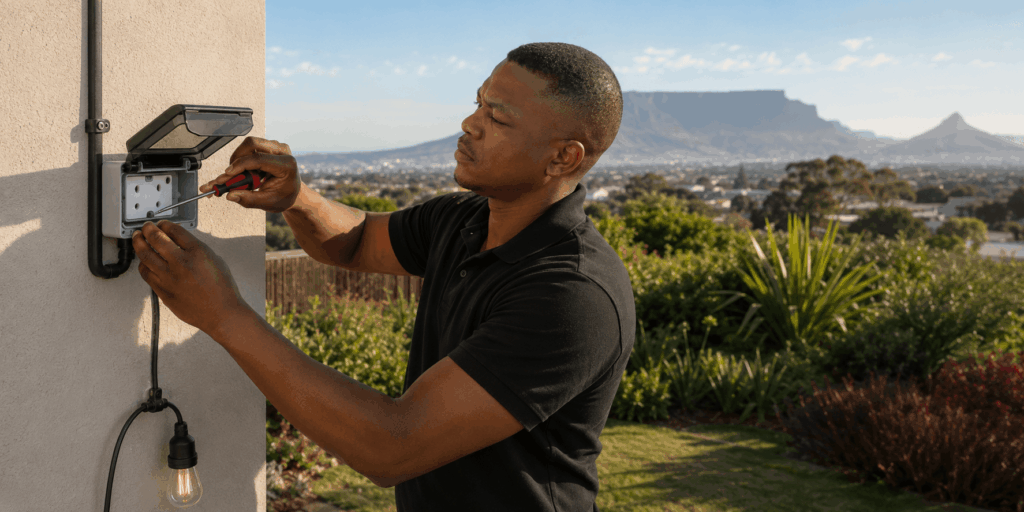
Battery and solar string lights are simple enough to hang yourself once the catenary system is in place. But the moment you are dealing with mains-powered festoon lighting, permanent outdoor sockets, or hard-wired garden lighting, you are into territory that legally requires a registered electrician in South Africa.
Outdoor electrical work in Cape Town’s wet winters and salt air carries real risk if done incorrectly. Every outdoor connection, socket, and fitting must be correctly IP-rated for water and dust ingress, and any new circuit must be issued with a Certificate of Compliance. This is not optional – it protects your home, your family, and your insurance.
Handyman Homes provides a registered electrician service across all Cape Town suburbs that handles weatherproof outdoor socket installation, mains festoon lighting, and full garden lighting schemes. If your outdoor lighting is part of a bigger patio or garden project, the general handyman team can handle the mounting, fixing, and catenary installation alongside the electrical work in a single visit.
Whether you are lighting a compact Sea Point balcony, a Woodstock courtyard, or a sprawling Constantia garden, getting the fixings and the electrics right is the difference between lights that last one weekend and lights that survive every South Easter the summer throws at them.
Frequently Asked Questions
How do I stop my string lights blowing down in Cape Town wind?
The key is to never hang string lights on their own cable. Run a separate tensioned stainless steel catenary wire between solid fixing points and clip the lights to that wire. The steel takes all the wind load. Combine this with stainless steel fixings, a slight droop in the cable, and turnbuckles for re-tensioning, and your lights will survive the South Easter.
What fixings should I use for outdoor lights on the Atlantic Seaboard?
Use marine-grade 316 stainless steel throughout – wire, turnbuckles, eye bolts, and hooks. The salt-laden air on the Atlantic Seaboard from Mouille Point to Camps Bay corrodes standard galvanised and mild steel fixings within a single season, causing lights to fail. Stainless steel is more expensive upfront but lasts many years.
Can I install mains-powered outdoor lights myself in Cape Town?
Battery and solar lights you can hang yourself. However, any mains-powered festoon lighting, permanent outdoor sockets, or hard-wired garden lighting must legally be installed by a registered electrician in South Africa, using correctly IP-rated weatherproof fittings and issued with a Certificate of Compliance. This protects your safety and your home insurance.
How tight should I tension outdoor string light wire?
Not bar-tight. A wire strung too tightly has no give and transfers the full force of every gust straight to the end fixings, which then fail. Leave a slight, deliberate droop of around 20 to 30cm over a typical span so the system can flex and absorb wind load. Use turnbuckles so you can re-tension after windy spells.
Are hanging lanterns a bad idea in windy Cape Town gardens?
Hanging lanterns are the most wind-vulnerable outdoor lighting because they swing and catch the wind. If you want them, hang them from a short rigid bracket rather than a long chain, choose open-frame designs that let wind pass through, and bring lightweight ones indoors when a severe South Easter is forecast. Fixed wall lanterns are a far more reliable choice.
How much does professional outdoor lighting installation cost in Cape Town?
Cost depends on the size of the run, the fixing points required, and whether mains electrical work is involved. A basic catenary and festoon installation is quoted per project, while mains-powered garden lighting with weatherproof sockets and a Certificate of Compliance costs more. Contact Handyman Homes for a free site assessment and quote.