



A faulty door lock is more than an inconvenience – it is a security risk. Whether your front door lock is stiff, intermittent, worn, or has been compromised after a break-in attempt, the question of whether to repair or replace is one that Cape Town homeowners face more often than they might expect.
Cape Town’s combination of coastal salt air, variable humidity, and unfortunately elevated property crime rates makes door lock maintenance more important here than in many other South African cities. A lock that stiffens slowly over months, or that has a key that has started to catch before turning, is telling you something. Understanding what it is telling you – and how to respond – is the focus of this guide. For a fast assessment and same-day repair or replacement, the Handyman Homes general handyman service covers lock work across all Cape Town suburbs.
Key Takeaways
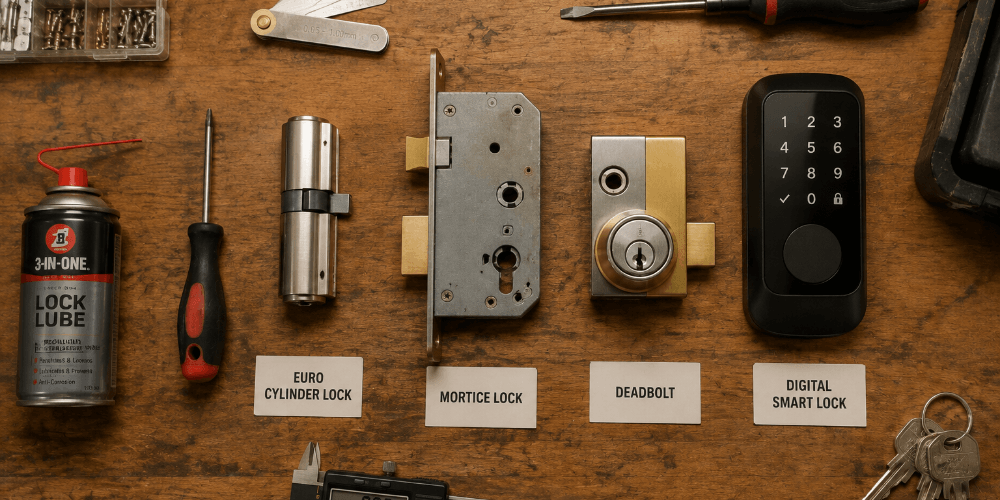
Before you can decide whether to repair or replace your lock, it helps to know what type of lock you are working with. Cape Town homes across different eras use several distinct lock systems.
Cylinder locks (also called euro cylinder or rim cylinder locks) are the most common type on external doors built or renovated from the 1990s onward. The cylinder is a replaceable barrel that sits inside a larger lock body. Replacing just the cylinder rather than the entire lock mechanism is often all that is needed – and is a job the Handyman Homes team handles in under an hour.
Mortice locks are set into a deep pocket cut into the edge of the door. They are common in older Cape Town homes – Victorian terraces in Woodstock and Observatory, Cape Dutch homes in the Southern Suburbs, and properties in De Waterkant often have traditional mortice locks. These are more complex to replace but extremely secure when in good condition.
Deadbolts are single-throw or double-throw bolts that engage directly into the door frame without a spring mechanism. They are often installed as secondary locks alongside a door handle set, particularly on security gates and solid timber front doors.
Smart locks and keypad entry systems are growing rapidly in Cape Town, particularly in sectional title apartments in the City Bowl, Sea Point, and Atlantic Seaboard areas.
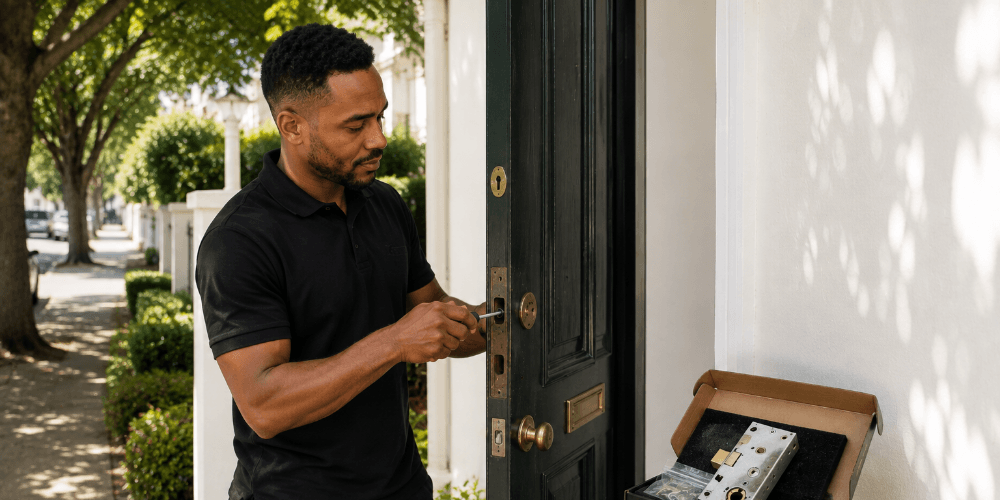
Not every failing lock needs to be replaced. Many issues are mechanical and entirely fixable at a fraction of the cost of replacement.
A lock that turns stiffly or requires significant force is usually suffering from dried-out or absent lubrication, a slight door or frame alignment issue, or minor internal corrosion. A thorough application of a dry PTFE lubricant and a check of the door alignment often restores the mechanism completely. This is a 20-minute job for a handyman.
If the key catches or sticks on the way in or out but the lock still functions, the keyway may need cleaning. A build-up of dust, graphite residue from old lubricants, and metal filings from key copies accumulates in the keyway over time. Clean with compressed air followed by dry lubrication to resolve this.
A latch that does not click fully into the strike plate, or that requires the door to be lifted slightly before the key works, is almost always a door alignment issue rather than a lock failure. Adjusting the strike plate position by 1-2mm or shimming the hinge is a repair, not a replacement.
Handles that wobble or a backplate that has pulled away from the door surface indicate that the mounting screws have loosened over time. Tightening or replacing the screws – occasionally with longer or larger-gauge screws if the original holes have worn – restores the handle to full function.
There are situations where repair is not enough. Replacing the lock entirely is the only way to restore security and function reliably.
Any lock that has been attacked – whether the cylinder has been drilled, the body has been bumped, or the door frame around the strike plate has been damaged – must be replaced, not repaired. A lock that has been forcibly stressed has internal components that may be compromised even if the mechanism appears to still work. In Cape Town’s security environment, do not delay this replacement. Contact Handyman Homes for an urgent call-out.
If the original key is visibly worn down from thousands of turns, or if multiple copies have been made over the years by previous tenants, contractors, or family members, replacing the cylinder or the entire lock is the most secure option.
Cape Town’s coastal salt air corrodes the internal pins, springs, and tumblers of a lock over time. A lock that functions intermittently – working on some days and not others – is exhibiting the classic symptom of internal corrosion. Lubrication will not fix a corroded internal mechanism. Replace it. The same salt-air corrosion that affects locks also affects electrical fittings and exterior hardware across coastal Cape Town properties.
A front door lock in active daily use has a finite mechanical lifespan. After 10 years of regular use, the internal components in most standard grade locks begin to show wear that affects reliability. Proactive replacement before failure is prudent – particularly when your front door lock is your primary security barrier.
If your current lock is a basic Grade 1 residential lock, upgrading to a Grade 2 or Grade 3 certified lock significantly increases resistance to bumping, picking, and drilling attacks. This is an especially relevant consideration for Cape Town homeowners in higher-crime areas.
The cost of replacing a door lock in Cape Town depends on the lock type, the security grade, and whether the replacement is a straight swap or involves modifications to the door.
Cylinder lock replacement is the most affordable option. A quality Grade 2 replacement cylinder costs between R350 and R800 for the hardware, with labour for a straight swap typically under R400. Total cost is usually R600-R1,200.
Mortice lock replacement is more involved, particularly in older Cape Town homes where door pocket dimensions may be non-standard. Budget R800-R1,800 for hardware and labour depending on complexity.
Smart lock installation costs vary widely – from entry-level keypad deadbolts at R800-R1,500 through to high-end systems with app connectivity at R3,000-R6,000 plus installation. For sectional title apartments in the City Bowl and Sea Point, the convenience and key management benefits often justify the higher cost. If the door or frame has also been damaged during a break-in, the Handyman Homes renovation team can repair the frame and replace the lock in the same visit.
Visit the Handyman Homes handyman page to get a quote for your specific lock situation.

Use this summary to make a fast confident decision about your door lock.
When in doubt, a professional handyman can assess the lock in minutes and give you an honest recommendation. There is no pressure to replace something that can be repaired – but there is also no good reason to keep a compromised lock on your front door in Cape Town.
Yes, in most cases. A stiff lock that still functions is usually suffering from dried-out lubrication, minor internal corrosion, or a slight door alignment issue. A dry PTFE lubricant applied to the keyway and mechanism resolves most stiffness. If the lock remains stiff after lubrication, a handyman can assess whether adjustment or replacement is needed.
For front doors, a Grade 2 or Grade 3 cylinder lock from a reputable brand such as Mul-T-Lock, Yale Platinum, or ASSA Abloy provides a good balance of security and convenience. For coastal properties from Sea Point to Llandudno, choose a corrosion-resistant model. Mortice locks remain an excellent choice for older Cape Town homes with timber doors.
Yes. Replacing all external door cylinders when you move into a new property is standard security practice. You have no way of knowing how many key copies exist or who holds them. A cylinder replacement is affordable and takes less than an hour per door.
Under normal daily use, a quality residential door lock lasts 10-15 years before reliability declines. In Cape Town’s coastal areas, salt air can shorten this to 7-10 years for standard-grade locks. High-security locks with corrosion-resistant components last longer.
For most standard lock replacements including cylinder swaps, deadbolt installations, and mortice lock changes, a qualified handyman has the tools and skills needed. A locksmith is specifically needed if you are locked out of your home. For planned replacements, a handyman is generally faster and more affordable.
Cylinder lock replacements typically cost R600-R1,200 including hardware and labour. Mortice lock replacement ranges from R800-R1,800. Smart lock installation starts at around R1,500 and can reach R6,000 or more for high-end systems. Contact Handyman Homes for a free quote.
Replace it immediately. A lock that has been tampered with may appear to function normally but can have compromised internal components. In Cape Town, a damaged or attacked lock should be replaced the same day if possible. Contact Handyman Homes for an urgent call-out.










2026 Copyright © Handyman Homes . All rights reserved. Created by Cooper Creative.