


A dripping tap is one of those home maintenance issues that seems minor right up until you get the water bill. In Cape Town, where water consciousness is a genuine community value and Day Zero is still a recent memory, a leaking tap is not something to leave for later. One dripping tap wastes around 10,000 litres of water per year – and that is before you factor in the cost of that water on your municipal account.
The good news is that many leaky taps are straightforward to fix with the right knowledge and tools. This guide walks you through the most common causes of a dripping tap, how to diagnose which type of tap you have, and the steps to fix it – or when to call a professional Cape Town plumber.
Key Takeaways

These have separate hot and cold handles that turn through approximately 360 degrees to open and close. You can feel resistance as the washer compresses against the valve seat. They are common in older Cape Town homes in suburbs like Woodstock, Salt River, Tamboerskloof, and the Gardens area. If you live in one of these older properties and are finding multiple plumbing issues at once, it may be worth considering a broader home maintenance assessment rather than fixing each issue individually.
These use a quarter-turn mechanism – the handle moves only 90 degrees from fully open to fully closed. Most modern taps installed in Cape Town homes from the 1990s onwards use ceramic disc cartridges. These are more durable but require cartridge replacement rather than washer replacement when they fail.
Mixer taps combine hot and cold into a single unit. They can be either washer-based or ceramic disc, with single-lever or dual-handle designs. Mixer tap repairs follow the same principles but may require accessing the cartridge from the top of the fitting. If you are considering upgrading your mixer tap as part of a bathroom renovation or kitchen renovation, a professional plumber can install new tapware at the same time as the repair visit.
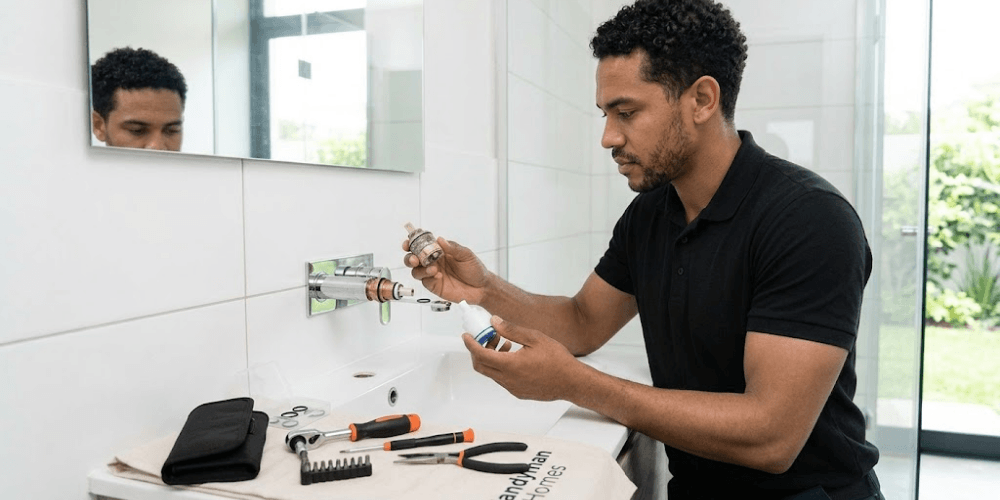
Step 1: Turn off the water supply at the isolation valve under the sink, or at the main stopcock if there is no isolation valve. Open the tap to release any remaining pressure and drain the water.
Step 2: Remove the tap handle. This is usually held by a screw hidden under a decorative cap at the top of the handle. Prise off the cap with a flat screwdriver, remove the screw, and lift off the handle.
Step 3: Use an adjustable spanner to unscrew the packing nut (the large hexagonal nut below the tap body). Keep a cloth underneath to catch any residual water.
Step 4: Pull out the headgear assembly. At the bottom you will see the washer – a small rubber disc held by a brass nut. Unscrew the nut, remove the old washer, fit the new one, and tighten the nut.
Step 5: Reassemble in reverse order. Before tightening the packing nut, apply a small amount of plumber’s grease to the threads. Turn the water back on slowly and test for drips.
Step 1: Turn off the water at the isolation valve. Open the tap to release pressure.
Step 2: Remove the handle by unscrewing the retaining screw under the decorative cap.
Step 3: The cartridge will be visible – it is a cylindrical ceramic component inside the tap body. It is typically held in place by a retaining nut or clip.
Step 4: Note the orientation of the cartridge before removing it. Take a photo. Remove it by unscrewing the retaining nut or releasing the clip, then pulling out the cartridge.
Step 5: Insert the new cartridge in exactly the same orientation. Refit the retaining nut or clip. Refit the handle, turn the water back on, and test.
If the isolation valve is seized and you cannot turn off the water to the tap, call a plumber immediately rather than attempting the repair. Similarly, if you discover a leak inside the wall, the tap body is cracked, or the repair has not resolved the drip after a second attempt, it is time to call a professional.
The Handyman Homes plumbing service covers tap repairs, washer and cartridge replacement, isolation valve replacement, and a full range of residential plumbing maintenance across Cape Town. If the leak has caused water damage to cabinetry or walls, the general handyman service can assess and repair the damage in the same visit.
We serve all Cape Town suburbs – contact us for a fast, transparent quote.
Many leaky taps can be repaired with basic tools and a new washer or ceramic cartridge. However, if you are not confident with plumbing, the tap is older and unusual, the isolation valve does not work, or you discover a larger leak, call a professional. An incorrectly repaired tap can cause flooding or ongoing damage.
Most dripping taps are caused by a worn washer or ceramic disc cartridge. Over time, the rubber or ceramic sealing components degrade from use and water pressure, allowing water to pass even when the tap is off. Other causes include a damaged valve seat, loose packing nut, or worn O-rings.
A dripping tap dripping once per second wastes around 30 litres per day – over 10,000 litres per year. In Cape Town, where water restrictions and consciousness of water use are both high, fixing a leaking tap promptly is both a practical and environmental responsibility.
Locate the isolation valve – typically a flat-head screw slot on the pipe under the sink or basin. Turn it 90 degrees to close. If there is no isolation valve, locate the main stopcock for the property, usually under the kitchen sink or near the water meter. Turn it clockwise to close.
Traditional washer taps use a rubber washer that compresses against a valve seat to stop water flow. These are repaired by replacing the washer. Ceramic disc taps use a pair of ceramic discs that rotate to control flow – these are repaired by replacing the cartridge. Ceramic disc taps are more common in modern Cape Town homes.
A basic tap washer replacement by a professional plumber in Cape Town typically costs R350 to R600 including labour and the cost of a new washer. Ceramic cartridge replacement costs slightly more – R500 to R900 including the cartridge. Handyman Homes provides transparent quotes before starting any plumbing work.







2026 Copyright © Handyman Homes . All rights reserved. Created by Cooper Creative.